COI Self-Service Redesign
COI Self-Service Redesign
Eliminating underwriting bottlenecks through intelligent, progressive data capture.
Eliminating underwriting bottlenecks through intelligent, progressive data capture.
Client
biBerk Insurance
Services
UX Design, UI Design
Industry
Insurance
Year
2024

The Problem
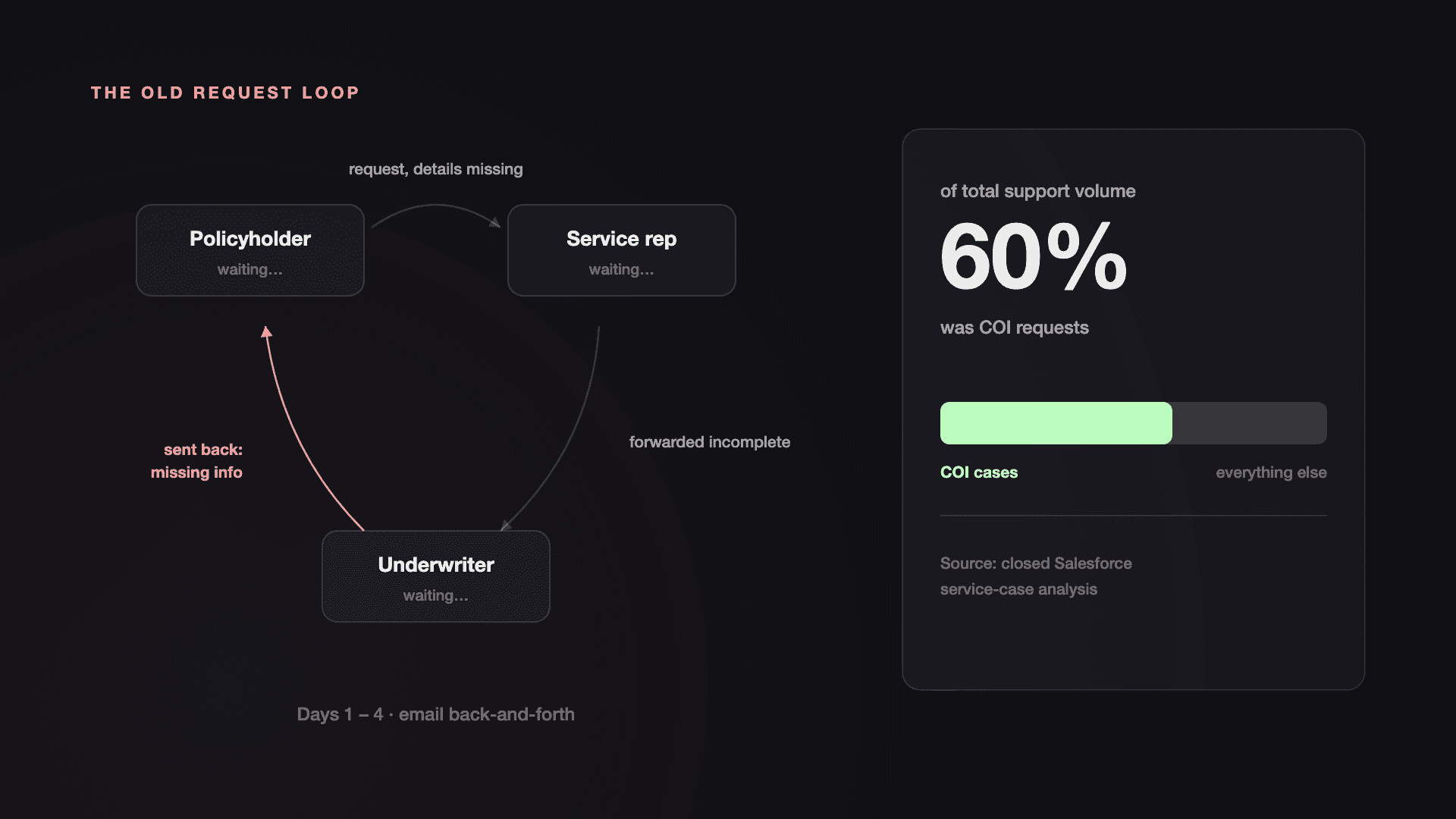
Analysis of closed Salesforce service cases revealed that over 60% of total support volume involved Certificates of Insurance (COI) requests. The core bottleneck was a lack of upfront data collection. Customers regularly submitted requests without providing necessary details regarding subcontractor work types or specific vehicle information. This initiated a multi-day, frustrating communication loop between policyholders, customer service representatives, and underwriters, driving up case backlogs and causing severe customer dissatisfaction.
Analysis of closed Salesforce service cases revealed that over 60% of total support volume involved Certificates of Insurance (COI) requests. The core bottleneck was a lack of upfront data collection. Customers regularly submitted requests without providing necessary details regarding subcontractor work types or specific vehicle information. This initiated a multi-day, frustrating communication loop between policyholders, customer service representatives, and underwriters, driving up case backlogs and causing severe customer dissatisfaction.
The Solution
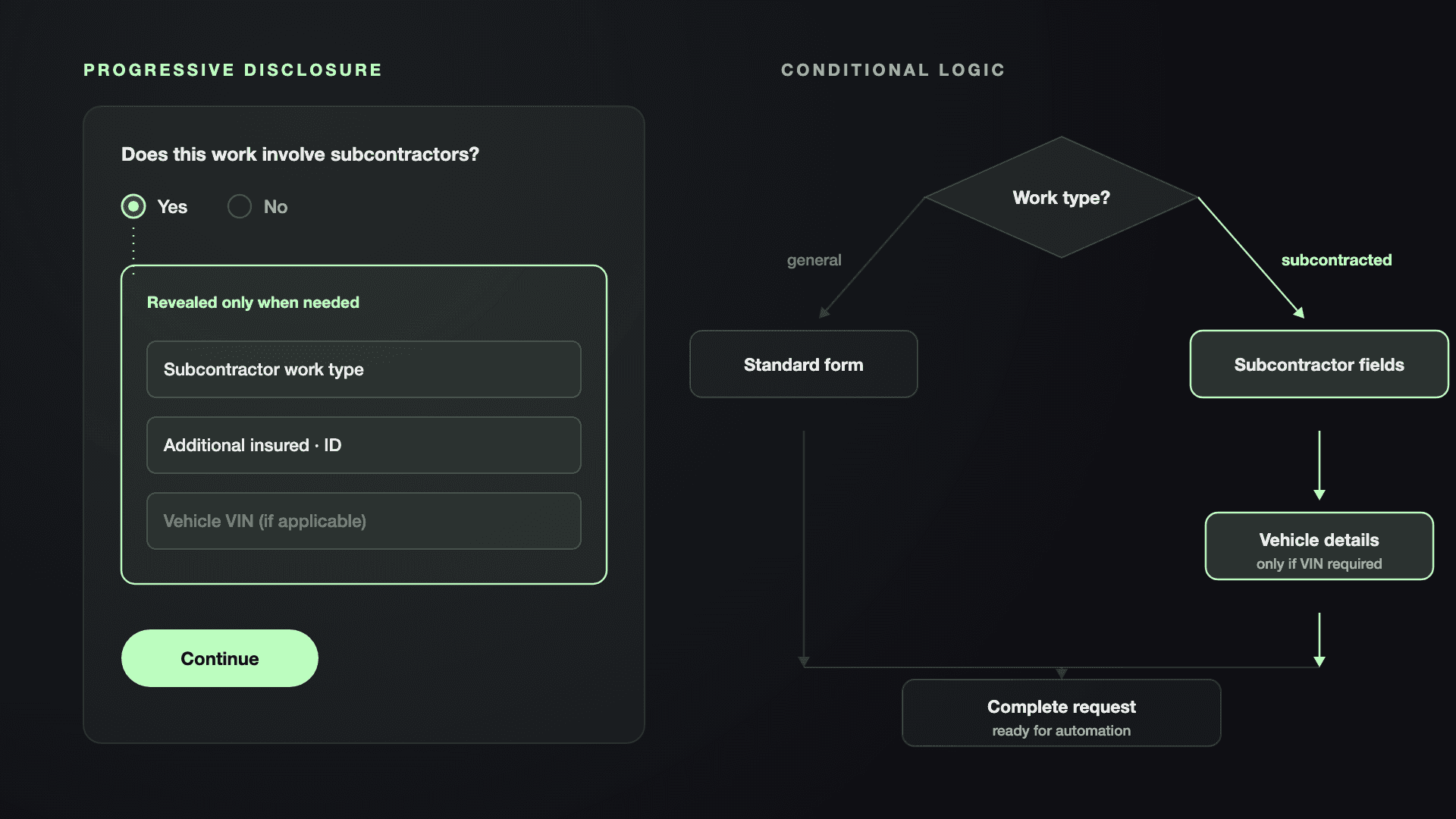
I redesigned the B2C self-service flow to mandate complete data capture at the source. Implementing progressive disclosure and conditional logic, the UI dynamically prompts users for specialized information—such as additional insured IDs or precise vehicle details—only when triggered by previous selections. I collaborated closely with product managers and underwriting to define the exact data matrix required for automated processing. All progressive form elements were built to strict accessibility standards, ensuring WCAG-compliant color contrast and full screen-reader compatibility for users navigating via keyboard.
I redesigned the B2C self-service flow to mandate complete data capture at the source. Implementing progressive disclosure and conditional logic, the UI dynamically prompts users for specialized information—such as additional insured IDs or precise vehicle details—only when triggered by previous selections. I collaborated closely with product managers and underwriting to define the exact data matrix required for automated processing. All progressive form elements were built to strict accessibility standards, ensuring WCAG-compliant color contrast and full screen-reader compatibility for users navigating via keyboard.
The Impact
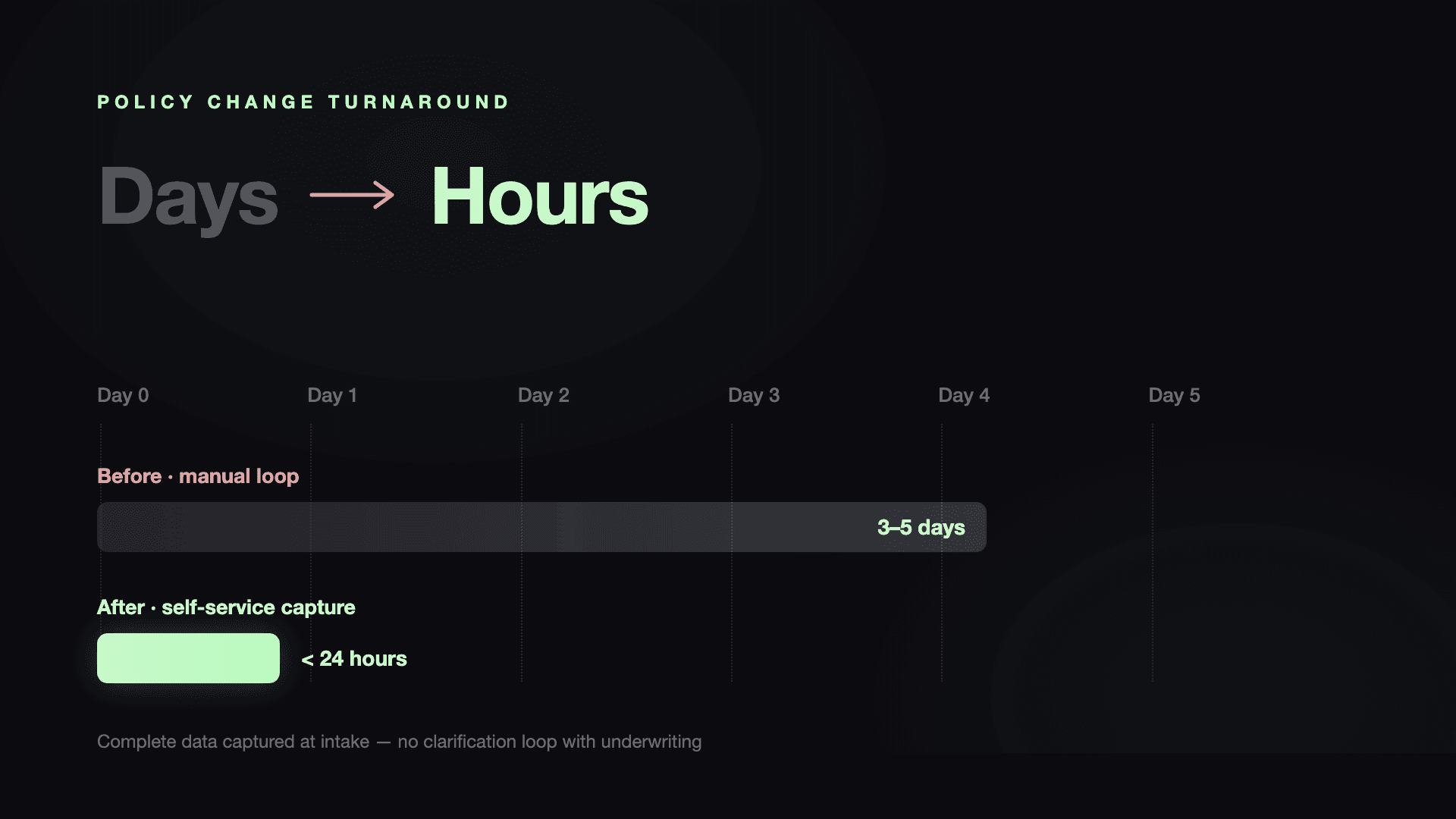
By enforcing accurate data collection upfront, the redesigned flow eliminated the primary underwriting bottleneck. Policy change turnaround times dropped drastically from multiple days to under 24 hours. Furthermore, the updated UI significantly decreased the volume of manual COI cases routed to service workers, allowing the business to handle rapid revenue scaling without a proportional increase in human support overhead.
By enforcing accurate data collection upfront, the redesigned flow eliminated the primary underwriting bottleneck. Policy change turnaround times dropped drastically from multiple days to under 24 hours. Furthermore, the updated UI significantly decreased the volume of manual COI cases routed to service workers, allowing the business to handle rapid revenue scaling without a proportional increase in human support overhead.